
A strategic framework for assuring and improving quality, equity and outcomes across statutory functions, in-house services and commissioned care.
CONTENTS
1. Introduction
This framework sets out how Adults, Health and Wellbeing will understand, assure and improve quality across statutory functions, in-house services and commissioned care. It defines quality by the difference made to the lives of people and unpaid carers, including whether support is safe, lawful, strengths-based, rights-based, equitable, timely, person-led and sustainable.
The framework is grounded in Living Better Lives in Lancashire, statutory duties, CQC assurance expectations and the commitment to improve equity of access, experience and outcomes for people who draw on care and support and unpaid carers. It is designed to support inspection readiness, board assurance and sustained improvement, but its primary test is whether people experience better, fairer and more consistent support in their daily lives.
2. Purpose
The purpose of this framework is to provide a consistent and strategic approach to quality assurance and improvement which helps create the conditions for learning and continuous improvement.
The framework explains how the directorate will gather and use a range of evidence to demonstrate the impact of our work on people’s lives and how we will act to learn and improve to reduce risk and variation. Using this framework, we will evidence how we are:
- Delivering our statutory responsibilities;
- Working in a strength-based and person-centred way;
- Using our policies and procedures to support best practice;
- Identifying gaps in our approach and areas for development;
- Learning and continuously improving;
- Using our resources effectively.
Quality assurance is owned by everyone across the Adults, Health and Wellbeing directorate. Our aim is to ensure that staff, at all levels, understand and routinely undertake quality assurance activity for themselves, with people they manage, their teams and across their service areas.
Quality assurance is most powerful when done collectively and only meaningful when used to drive continuous improvement.
This framework sets out:
- The principles for quality assurance and improvement;
- The key questions to consider;
- The types of evidence we need to provide assurance;
- How we should use that evidence to learn and improve.
3. Our Vision
Our vision is to enable people to live better lives in Lancashire. We are working to:
- Help people live independently and safely;
- Provide the right support at the right time;
- Deliver care close to home;
- Improve access to information and advice;
- Strengthen neighbourhood working;
- Ensure personalised, strengths‑based practice.
The framework provides the mechanism for assuring we are delivering on our vision and genuinely making a difference to people’s lives and keeping them safe from harm.
4. Scope
This framework is applicable to all of Adult Social Care. It covers:
- Statutory social care functions;
- Directly provided services;
- Commissioned services.
It does not replace existing operational procedures, audit tools, provider monitoring arrangements, practice guidance or approval frameworks. Instead, it provides the umbrella model for quality assurance and improvement to support managers and teams to ensure robust quality assurance is undertaken and fundamentally understanding whether our work is making a difference to people’s lives.
5. Principles for Quality Assurance
These principles will ensure that quality assurance and improvement work is undertaken consistently.
5.1 Evidence based
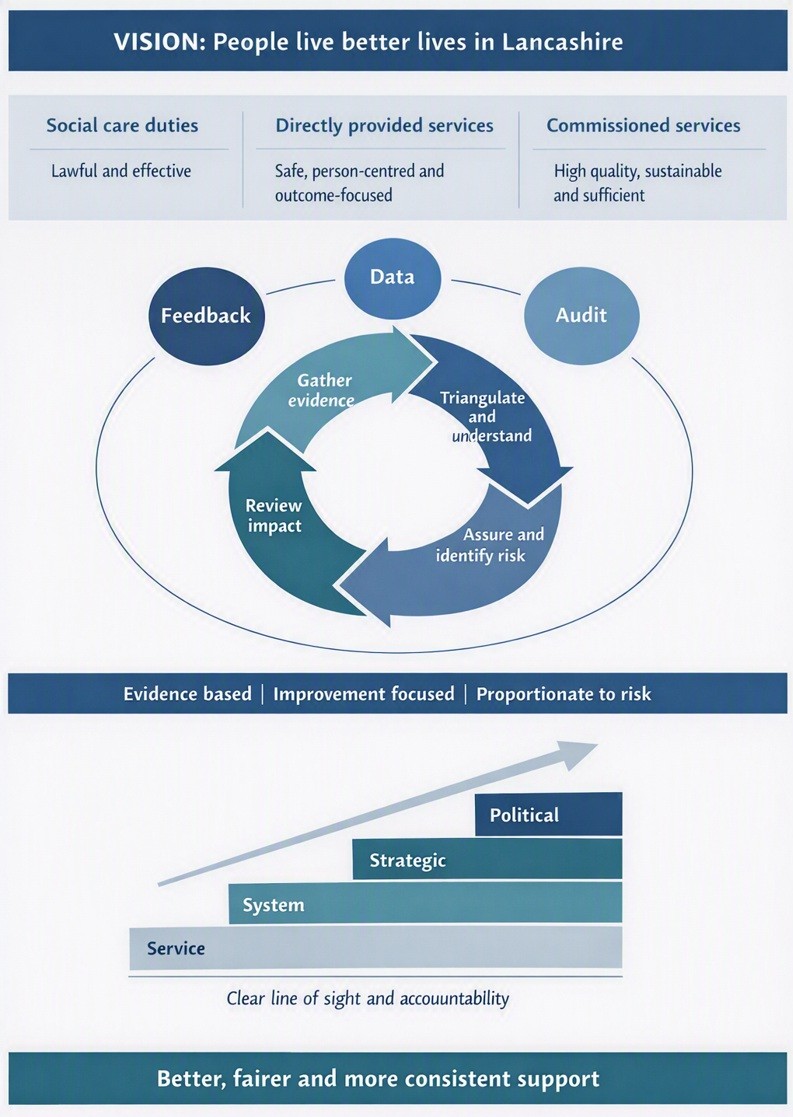
Our understanding of quality and whether we are having a positive impact on people must be evidence based. This framework seeks to develop a thorough understanding of quality and recognises that multiple sources of information are required to do this. Evidence should be triangulated which means more than one piece of evidence will be used to confirm something has happened; or, that what is being described in one way is supported in another. The three primary evidence sources are:
- Feedback;
- Data;
- Audit.
5.2 Improvement focused
The main outcome of quality assurance is to ensure that our services are helping people to live a better life. If evidence highlights areas of weakness or where things could improve, the focus is on how we learn as individuals and as an organisation and share that learning to improve what we do. Although we are all accountable for what we do, quality assurance should never be about finding fault and apportioning blame.
5.3 Proportionate
We have a range of duties and deliver a diverse range of services; our quality assurance work should proportionately focus on risk rather than taking a one size fits all approach. For example – where services deliver to large volumes of people, where people are at heightened risk because of their needs, where there is a high-cost value, where we have a legal duty or where there is other heightened risk, then these elements of our work should receive greater attention.
6. Our Approach to Quality Assurance and Improvement
Our approach to quality assurance is to focus on three primary areas which have the greatest impact on people’s lives – our social care duties, our role as a provider and our role as a commissioner of care and support.
Table 1 – Areas of Assurance and Key Assurance Question
| Area of assurance | Primary assurance focus | Key assurance question |
| Social Care duties | Care Act duties, prevention, wellbeing, assessment, review, safeguarding, Mental Capacity Act, lawful decision-making, equity of access and partnership working. | Are statutory duties being discharged lawfully, proportionately and in ways that improve people’s lives?
|
| Directly Provided Services | Quality, safety, experience, outcomes and leadership of directly delivered services, including reablement, day opportunities, residential care, supported living and short-term support. | Are directly provided services safe, person-centred, strengths-based, outcome-focused and do they improve people’s lives? |
| Commissioned Services | Market sufficiency, provider quality, commissioning outcomes, provider risk, continuity of care, sustainability, innovation and market resilience. | Are commissioned services high quality, safe, sustainable and provide value for money?
Do we have sufficiency in the market? |
7. Evidence Model
Table 2 describes the quality assurance activities and evidence used to provide assurance and identify improvement priorities. The evidence is grouped into three categories – feedback, data and audit, and applies to each assurance area in Table 1.
Wherever possible, assurance should draw on a combination of feedback, data and audit findings. People’s feedback should be given particular weight, helping to confirm and add context to evidence from data and audits.
Table 2 – Evidence Model
| Evidence Category | What it tells us | Examples of evidence we will use to provide assurance |
| Feedback | ||
| People’s experience | Our impact on people’s lives and experiences and things we should do to improve. | Surveys, complaints, compliments, comments, national surveys, advocacy, Healthwatch, community insights, stories and co-production activity.
|
| Staff experience | What it feels like to work in adult social care in Lancashire – what’s good and what could make things better. | Council surveys, annual health check, themed staff surveys, ASYE survey, feedback from engagement sessions, provider workforce surveys. |
| Data | ||
| Process | How effective we are – measuring things like volume, timeliness, quality, risk, market quality and sufficiency. | Performance dashboards – eg waiting times, assessments, reviews.
Other data returns, provider returns. |
| Workforce | Our capacity to deliver our duties and ensure sustainable services. | Workforce dashboard – eg absence, turnover, vacancies, agency use
Information returns from providers, Skills for Care data. |
| Finance | Our ability to balance the budget and deliver good value for money | Finance dashboard – eg budget reports, cost of care, savings. |
| Audit | ||
| Social work practice | How well we deliver our statutory social care functions in line with the Care Act, Mental Health Act and Mental Capacity Act ie is practice lawful, strengths-based, rights-based, defensible and making a difference. | Audits of practice, AMPH audits, funding approvals, supervision, safeguarding reviews, Mental Capacity Act practice, professional judgement, case discussion, peer review and practice learning. |
| Provider | Our ability to deliver and commission high quality and safe services in line with CQC standards
|
Audits of provider quality eg structured assurance assessments, responsive QA visits, observations, supervision, medication, case file, training, Infection Prevention Control. |
8. Continuous Improvement
Continuous improvement means using feedback, data and audit findings to understand what is working well, where quality or outcomes vary, and what needs to change. For our assurance work to be meaningful, we must have a system and culture of continuous improvement.
Everyone can learn and make changes to improve, these can be at an individual level, team or service level or wider organisational level. Importantly, learning should be shared across teams, services, providers and partners in a supportive, improvement-focused way to ensure improvements can have the greatest impact for people.
Ways in which learning can be shared:
- Supervisions;
- Team meetings;
- Peer group discussions;
- Service Management meetings;
- Senior Leadership Team;
- Directorate Leadership Team.
Learning should be translated into actions with named owners, timescales and measures of impact. Progress will be reviewed through governance arrangements to confirm that changes are embedded and delivering sustained improvements to people’s experience and outcomes.
Types of action that may arise from our learning include:
- Training and Continuous Professional Development (CPD) sessions – ensure staff have the right skills and knowledge. For example, in response to complaints about poor cleanliness in a care home alongside data which says numbers attending training is low and a recent poor Infection Prevention Control audit, training has been actioned for staff on infection prevention control.
- Changing policy, process and systems – learning used to improve how our systems, such as our Liquidlogic system, enable us to deliver the best possible experience and outcomes for people. For example, data says people are waiting longer for a service, whilst staff have fed back they are getting frustrated because of ‘hand-offs’ in the system. A simple system change has been made which removes the ‘hand-off’ and reduces the time it takes to complete the task, thereby freeing up time for staff and improving the experience for the person.
- Quality improvement interventions – where evidence is pointing to risk in our system then actions can be taken. For example, incident data has flagged a provider as a quality concern, this concern is strengthened by recent complaints by family members. A quality assurance visit is organised to do a deeper dive into the issue and identify any immediate supportive actions that need to be taken to safeguard people.
9. Standards
Where they exist, we will use external standards such as:
- Law and statutory guidance;
- CQC Standards;
- NICE guidelines;
- The Knowledge and Skills Statement and Professional Capabilities Framework for Social Work;
- Social Work England Standards.
- The Health and Care Professions Council (HCPC) standards of proficiency for Occupational Therapists.
We will benchmark our performance against similar authorities using the Adult Social Care Outcomes Framework and other available information
We will use the Lancashire County Council’s Corporate Measures set out in the council’s plan.
We will use local measures, such as the case file audit criteria.
10. Governance and Accountability
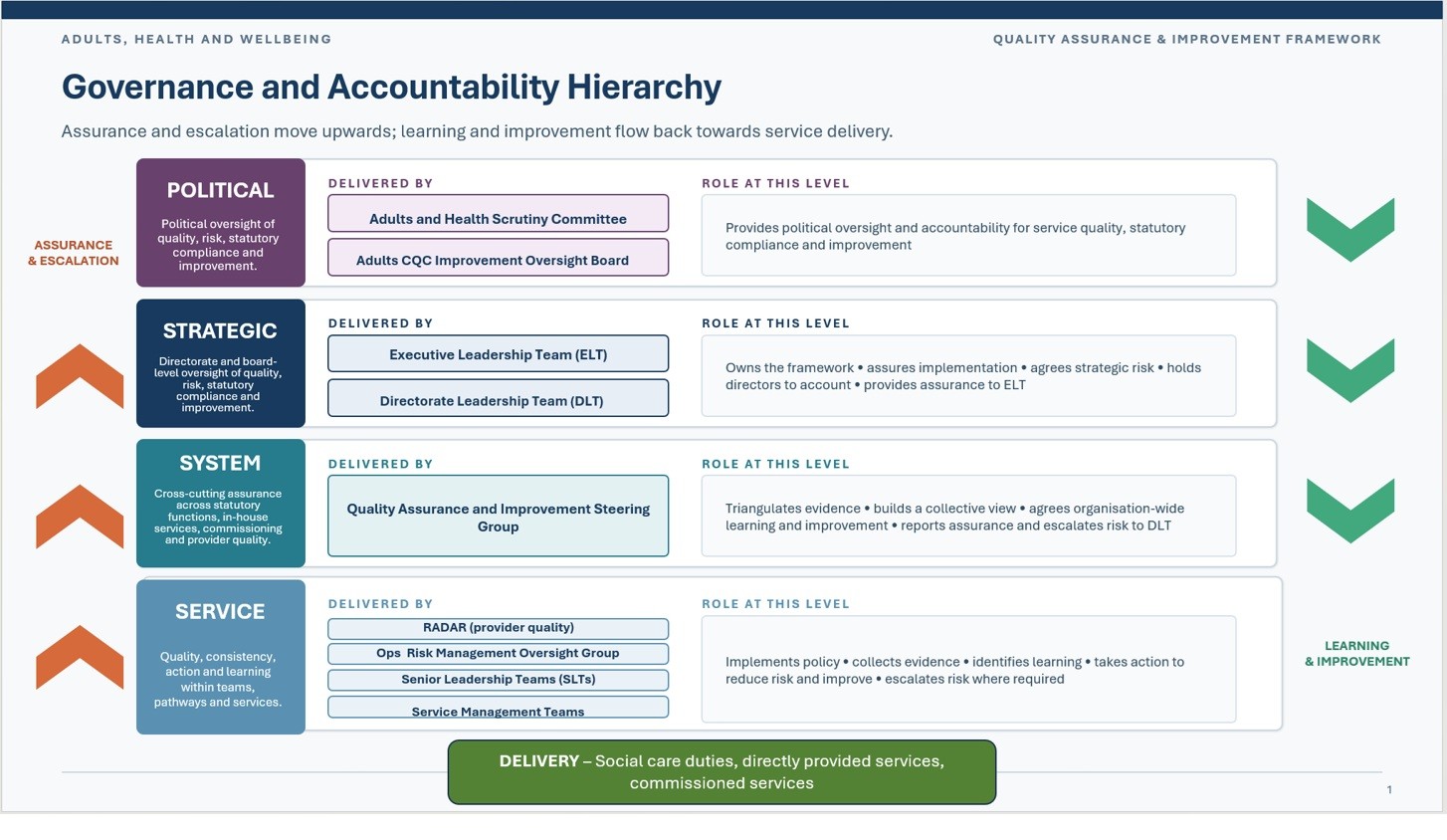
Governance will ensure a clear line of sight from people’s experience and frontline practice through to directorate-level assurance and improvement. Quality information should be reviewed at the right level, with risks, themes and actions escalated where they require wider ownership, decision or support.
Table 3 – Governance and Accountability Model
| Level | Purpose | Focus | Who |
| Service | Quality, consistency and learning within teams, pathways and services. | Implementing the policy.
Ensuing evidence is collected.
Identifying learning and actioning improvement. Escalating risk where required. |
Service Management Teams
Senior Leadership Teams (SLTs)
RADAR (provider quality)
|
| System | Cross-cutting assurance across statutory functions, in-house services, commissioning and provider quality. | Central group for quality assurance and improvement
Establishes collective understanding of what the evidence is telling us and agrees organisational level learning and improvement actions. Reports to DLT to provide assurance and escalate risk.
|
Quality Assurance and Improvement Steering Group |
| Strategic | Directorate, board-level oversight of quality, risk, statutory compliance and improvement. | DLT owns this policy.
Assurance of policy implementation and agreeing strategic risk.
Assurance of improvement and holding directors to account. Provision of assurance to ELT. |
Directorate Leadership Team (DLT)
Executive Leadership Team (ELT)
|
| Political | Political oversight of quality, risk, statutory compliance and improvement. | Accountable for the overall quality or services, statutory compliance and improvement. | Adults CQC Improvement Oversight Board
Adults and Health Scrutiny Committee |
Appendix 1 – Quality Assurance and Improvement Framework
Quality Assurance and Improvement Steering Group
Purpose
The Steering Group’s role will be to ensure the Quality Assurance Framework is being implemented consistently across the Directorate and to drive a culture of improvement. Specifically, the steering group will:
- Triangulate evidence at directorate level;
- Identify risk and learning themes and implement mitigating actions/escalate as required;
- Escalate risk to Directors and DLT.
Membership
- Head of Quality Assurance and Improvement (Chair);
- Principal Social Worker;
- Principal Occupational Therapist;
- Quality leads – practice, commissioning and provider services;
- Complaints and compliments lead;
- Safeguarding representative;
- Co-production lead;
- Performance and intelligence representation;
- Workforce learning and development representation;
- Operational practice representation (if different to quality lead);
- Other people, teams or partners invited in relation to specific themes, learning reviews or improvement actions.
Specific Terms of Reference
- To oversee the quality assurance framework across statutory social care practice, commissioning, provider services and people’s experience, ensuring it supports the evidence base for CQC improvement and local authority assurance.
- To bring together evidence gathered under the QA framework and triangulate in order to develop a rich and rounded understanding of quality.
- To ensure the principles of the framework are being adhered to.
- To strengthen the link between assurance, learning and impact by identifying what has been learned, what action is needed, who is responsible, and how the group will know whether action has made a difference.
- To use existing partnership boards and lived experience forums wherever possible to ensure that people who draw on care and support and unpaid carers shape assurance priorities and improvement activity in meaningful, non-tokenistic ways.
- To identify gaps in lived experience, carer and community representation and agree how these should be addressed or escalated through partnership arrangements.
- To maintain oversight of quality improvement actions, requiring responsible officers or teams to provide concise updates on delivery, barriers, learning and impact.
- To escalate themes, risks, inequalities, barriers or decisions required to Directors and DLT.
- To prepare the quality dashboard and narrative for DLT.
- To provide detailed assurance to DLT on CQC improvement actions.
- To develop a communications plan to support the sharing of learning and the creation of a continuous improvement culture.
Implementation Plan
| Category
|
Action | By when | Who |
| Approval | Policy to DLT for approval | October 2026 | Director Commissioning and Quality
|
| Governance | Establish Quality Assurance and Improvement Steering Group | October 2026
|
Head of QA
|
| Governance | Policy shared at SLTs | October & November 2026 | Head of QA
|
| Governance | Comms plan for launch | September 2026 | Strategic Comms Lead.
|
| Governance
|
Learning and Improvement – Standing agenda item on team meetings/SLTs
|
January 2027 | Head of QA |
| Workforce engagement | Staff workshops
|
October | Head of Change and Innovation
|
| Training
|
QA and Improvement Guidance and toolkit
|
December 2026 | Head of QA |
| Training
|
Training/awareness for staff | January 2027 | Head of QA |
| Evidence | Launch new customer survey | September 2026 | Strategic Comms Lead.
|
| Evidence | Roll out of new audit tool and approach | September 2026 | Head of QA
|
Governance and Accountability Hierarchy